






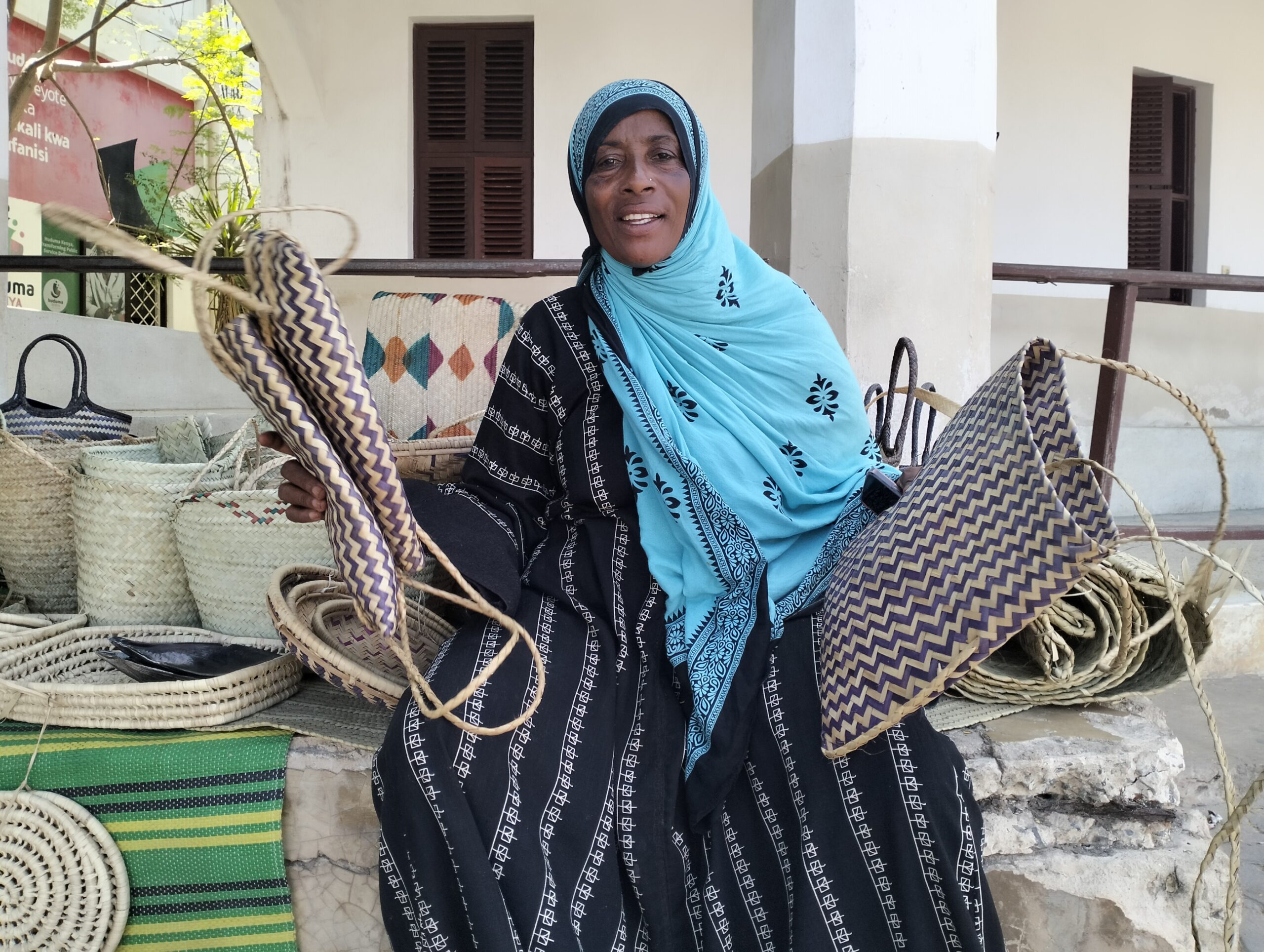
Along the pristine stone sea wall of Lamu Old Town, where the blue waves of the Indian Ocean gently lap against ancient wooden dhows, fifty-year-old Hadija Shee Baari sits surrounded by an explosion of texture and colour. Every time the historic island town bursts into celebration for major calendar events like the annual Lamu Cultural Festival, the spiritual Maulid Festival, or the joyous tides of Eid-Ul-Fitr, Ms. Shee is a fixture along the bustling oceanfront.
Tucked into her familiar corner, surrounded by intricately plaited palm strip baskets, vibrant floor mats, structured handbags, tailored kofias, and woven water bottle holders, she greets curious tourists and locals alike with a quiet, welcoming smile. For Ms. Shee, a resident of nearby Matondoni village, these handcrafted items are far more than mere souvenirs; they represent a lifelong journey of cultural preservation, female empowerment, and economic resilience.
Her passion for basketry began forty-four years ago in the heart of Matondoni, a village renowned across the Lamu Archipelago for its rich history of dhow building and traditional craftsmanship. At just six years old, young Hadija would sit quietly for hours, her eyes glued to the deliberate, rhythmic movements of her mother’s and aunts’ fingers as they manipulated dry palm fronds and river reeds.
In Swahili-Bajuni culture, palm plaiting is a sacred craft passed down through generations of women, blending artistic expression with domestic utility. What started as a child imitating her elders soon turned into a deep-rooted mastery, as Ms. Shee moved from plaiting simple single-strand strips to creating complex geometric patterns, dyeing natural fibers in vivid tones, and constructing durable, stylish artisanal goods that tell the story of her heritage.
Today, four decades after learning her first weave, that childhood passion has transformed into a robust financial engine for Ms. Shee and her family. In a region where formal employment opportunities can be scarce, basketry and mat weaving have provided her with complete financial independence and the means to raise her seven children.
Depending on the size, intricate design, and decorative elements required by her customers, her products range in price from seven hundred shillings for smaller accessories like bottle holders and kofias, up to seven thousand shillings for large, multi-textured floor mats crafted in circular, oval, or square shapes. This sustainable income stream has allowed her to pay school fees, cover medical bills, and ensure her household’s daily needs are met without relying on external aid.
The financial reward of her craft peaks during the high tourist seasons of August, November, and December, when holidaymakers from across Kenya and around the world flock to the UNESCO World Heritage site. During the height of the Lamu Cultural Festival, when the narrow stone alleys and waterfront promenades overflow with visitors, Ms. Shee experiences extraordinary sales volumes.
In a good season, she earns between ninety thousand and one hundred thousand shillings a month, occasionally pulling in twenty thousand to thirty thousand shillings in a single booming day. This financial security has even allowed her to diversify her economic footprint, utilizing her weaving profits to launch a secondary venture supplying fresh fish to households across Matondoni village.
Yet, for Ms. Shee, success is not measured solely in bank notes, but in the survival of her ancestors’ traditions. Deeply concerned that modern digital distractions and changing lifestyles might lead to the extinction of traditional Bajuni weaving, she devotes one day every week to training local youth completely free of charge.
In her informal workshops, she mentors a group of ten young men and women, walking them through the meticulous process of harvesting, drying, dyeing, and plaiting palm fronds. Community elders like Mohamed Bakari have warmly praised her selfless initiative, noting that while many young people overlook traditional handcrafts, Ms. Shee is giving the younger generation a practical blueprint for self-reliance, cultural pride, and community resilience.
Despite her unwavering dedication, Ms. Shee acknowledges that the path of an independent artisan is fraught with seasonal instability. When the tourist crowds disperse and the island enters its low season, sales can drop drastically, leaving weavers without steady income for months at a time. To combat this vulnerability, she is calling on both county and national government authorities to step in and establish reliable, structured market access for coastal weavers.
Beyond policy demands, her message to unemployed Kenyan youth remains one of proactive self-empowerment; she urges young people to stop waiting for scarce office jobs and instead embrace creative, hands-on self-employment like basketry, coconut recycling, and local crafts to weave their own secure futures.